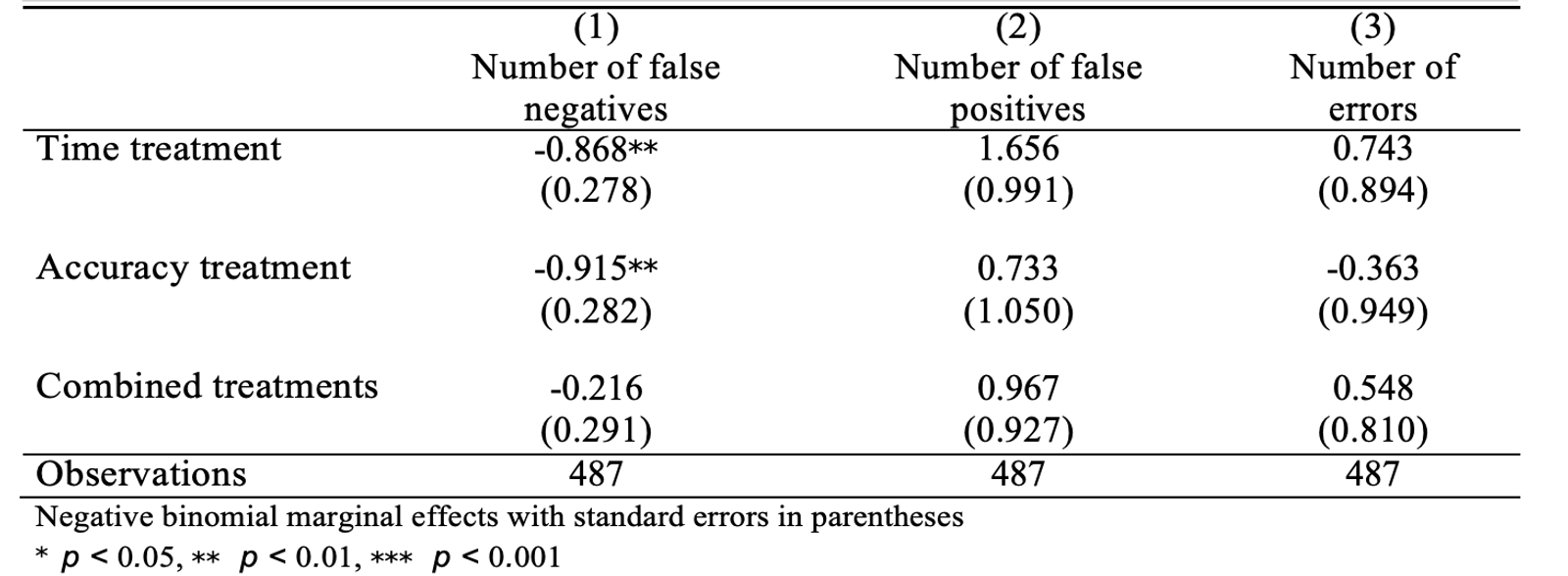
We developed an experimental model to study accuracy of human oversight in the financial services industry.We study the “eye glaze syndrome” as a case of sustained attention during complex mathematical cognitive tasks. We show that the error rate in repetitive identification of mathematical errors can be decreased by two simple interventions: targeted performance incentives and adaptive time warning. Additionally, we find that time spent on identifying mathematical errors may help identify false negatives under certain conditions. Our findings show promise for further research, the results of which could be applied to the development of algorithms to improve performance in financial services by lowering the risk of human oversight errors.